
H2IF shares key lessons on scaling clean energy innovation at the CETPartnership FOAK Forum
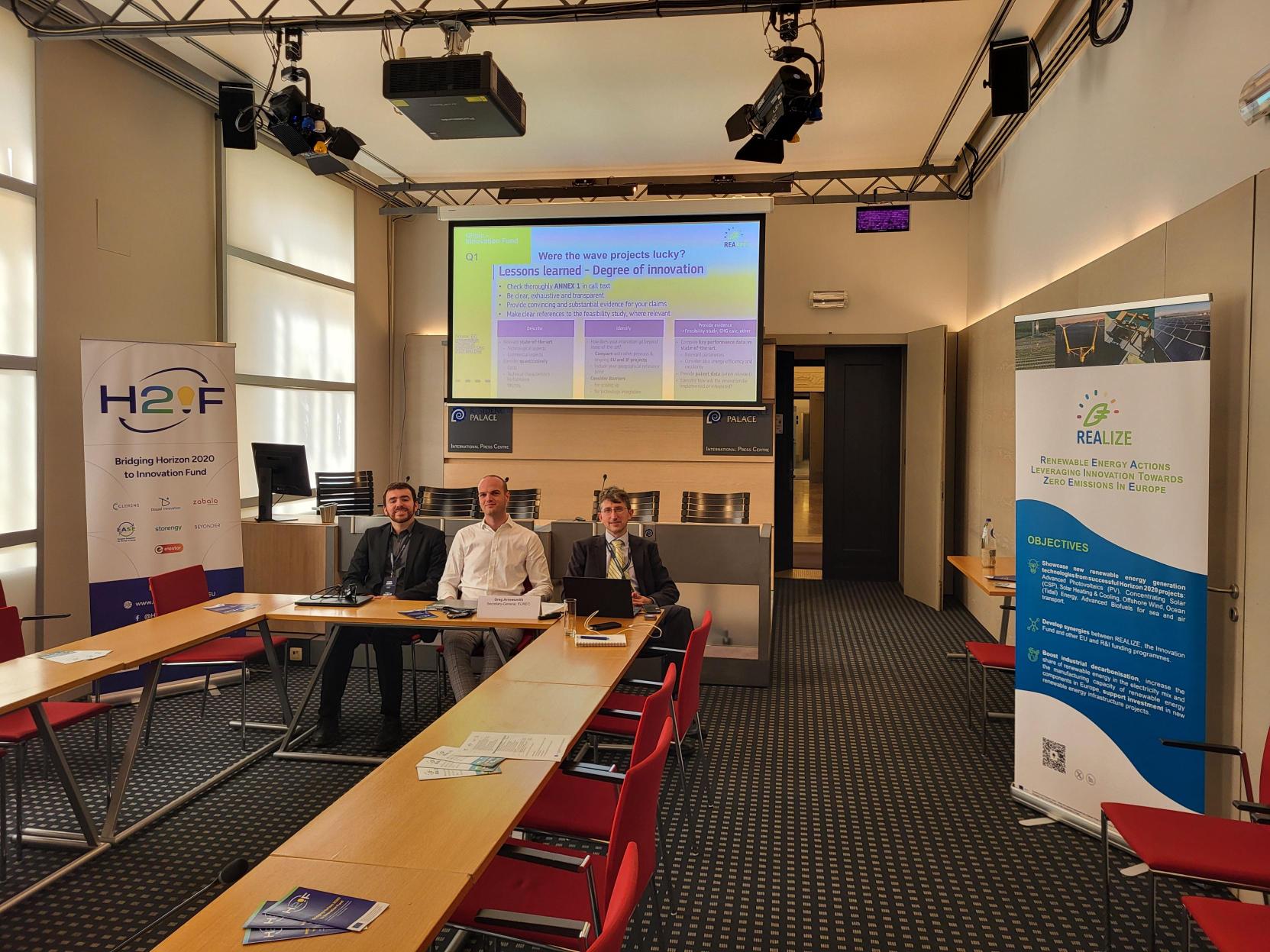
On 29 October 2026, the H2IF project participated in the “FOAK Forum: From Innovation to Industrial Deployment”, organised by the Clean Energy Transition Partnership (CETPartnership). During the event, H2IF Project Coordinator Federico Spadaro (CLERENS) delivered a keynote speech presenting the project’s main achievements and lessons learnt on bridging the gap between research and innovation (R&I) and industrial deployment.
Bridging the gap between innovation and industrial deployment
Europe generates a wealth of promising research and innovation results, particularly in clean energy technologies. However, translating these innovations into commercially viable, large-scale industrial projects remains a significant challenge.
This transition, often referred to as the R&I “valley of death”, is hindered by several factors, including limited access to scale-up financing, fragmented innovation ecosystems, insufficient industrial partnerships and the difficulties of moving from technological demonstration to commercial readiness.
Addressing these challenges was the central theme of the CETPartnership FOAK Forum, which brought together stakeholders to discuss the barriers preventing promising technologies from reaching First-of-a-Kind (FOAK) industrial deployment.
During his keynote, Federico Spadaro presented H2IF’s experience in supporting innovative energy storage and hydrogen technologies towards market readiness, highlighting the project’s main achievements and practical findings.
H2IF: connecting Horizon-funded innovation with the EU Innovation Fund
The H2IF project aims to facilitate the transition of promising R&I results in the energy storage and hydrogen sectors towards industrial readiness and market deployment.
In particular, the project focuses on strengthening synergies between Horizon-funded R&I projects and the EU Innovation Fund, one of the EU’s key financing instruments supporting the commercial demonstration and deployment of innovative low-carbon technologies.
Throughout its activities, H2IF has worked on identifying promising technologies emerging from Horizon-funded projects, assessing their potential for industrial scale-up, developing guidance materials for innovators and supporting the preparation of three Innovation Fund proposals.
These activities have also enabled the project to collect valuable insights into the challenges and best practices encountered during the transition from research to industrial deployment.
Key lessons learnt: why successful innovation does not always translate into market deployment
A central part of the keynote focused on the findings presented in H2IF’s report “Innovation pipeline and lessons learnt on challenges and best practices to R&I upscale” (D6.2, expected publication around Q3 2027).
Building on approximately three years of project activities, H2IF identified several recurring barriers affecting the scale-up of innovative technologies, alongside practical approaches that can help innovators anticipate and address them.
One of the main findings is that the barriers to industrial deployment are frequently not exclusively technical, but also commercial, financial and organisational. While R&I projects naturally prioritise technological development and validation, critical aspects such as business planning, market positioning, financing strategies and intellectual property management may receive insufficient attention.
Another key finding concerns the timing of market-readiness activities. The transition towards industrial deployment should not be treated as an exercise undertaken only upon completion of the research project. Instead, relevant activities should be progressively integrated into R&I planning from the earliest stages.
The project also highlighted the importance of early stakeholder engagement. Involving industrial partners, potential customers, investors and other value chain actors can help innovators better understand the commercial and operational requirements for successful deployment.
Finally, H2IF identified several external challenges, including market uncertainty, regulatory constraints, financing limitations and inconsistencies between R&I and deployment timelines. Although innovators cannot always directly address these barriers, recognising them early can support more realistic scale-up strategies and risk mitigation.
From lessons learnt to practical guidance: the H2IF scale-up framework
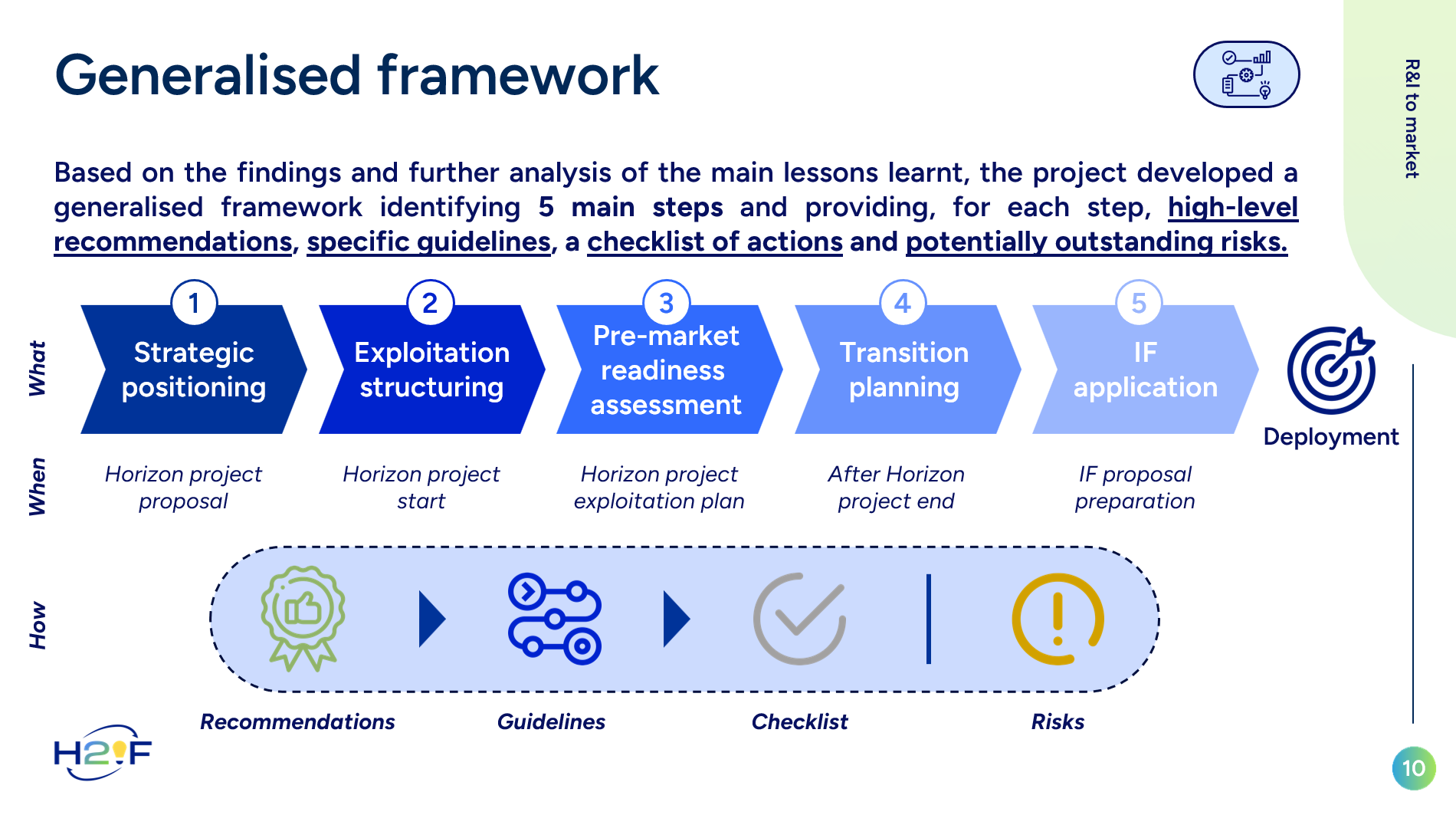
Building on these findings, H2IF developed a generalised framework to guide innovators through the transition from research to market deployment.
The framework is organised around five interconnected steps, covering strategic positioning, exploitation structuring, preliminary market-readiness assessment, transition planning and Innovation Fund application preparation.
For each step, it provides high-level recommendations, practical guidelines, checklists of relevant activities and considerations on potential risks.
The framework reinforces the principle that market readiness is a progressive process rather than a single milestone. Commercial, financial and organisational maturity should develop alongside technological maturity, allowing innovators to prepare more effectively for industrial deployment.
Although primarily developed in the context of energy storage, hydrogen and Innovation Fund applications, the framework can also provide useful guidance for innovators working in other clean energy sectors.
Supporting a stronger European innovation pipeline
The discussions at the CETPartnership FOAK Forum reinforced the relevance of H2IF’s findings within the broader European clean energy innovation landscape.
Accelerating industrial deployment requires more than successful R&I activities or access to individual financing instruments. It also calls for stronger connections between research, industry and investors, as well as greater continuity between the successive stages of technological development and commercialisation.
By identifying recurring barriers, collecting best practices and developing practical guidance for innovators, H2IF contributes to strengthening the European innovation pipeline and supporting the market uptake of innovative clean energy technologies.
H2IF thanks CETPartnership for the opportunity to share its experience and contribute to the discussion on accelerating Europe’s clean energy transition.
Find out more
- H2IF findings and lessons learnt: https://energystorageeurope.eu/news/h2if-shares-lessons-on-scaling-clean-energy-innovation/
- H2IF project website: https://h2if.eu/
- CETPartnership FOAK Forum: https://cetpartnership.eu/events/foak-forum-from-innovation-to-industrial-deployment/