

H2IF joins EU clean industry stakeholders in Brussels to accelerate the deployment of innovative low-carbon technologies
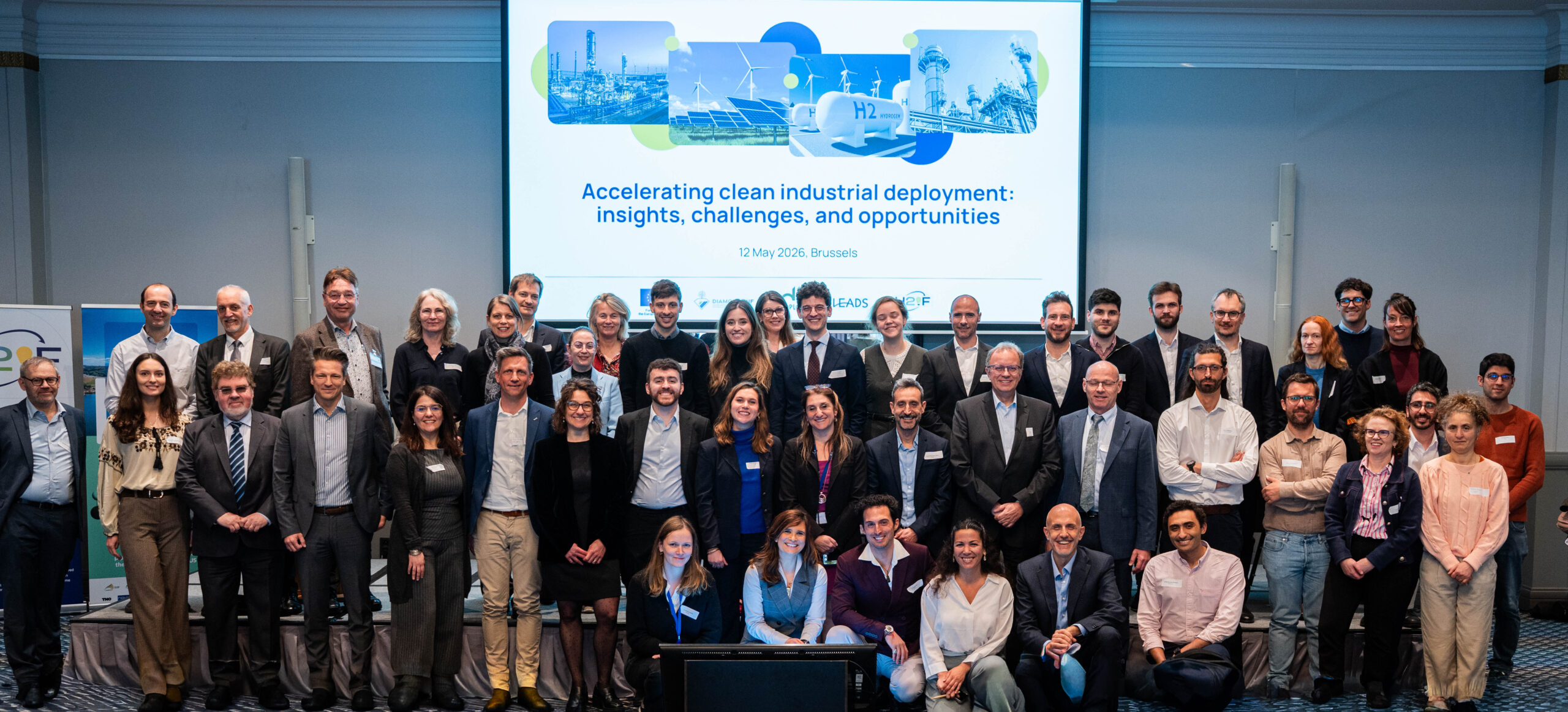
On 12 May 2026, H2IF, together with sister projects (DIAMONDS4IF, LEADS, 2DPLOY, and with the support of REALIZE), organised the public event “Accelerating clean industrial deployment: insights, challenges, and opportunities”, held at the DoubleTree by Hilton in Brussels.
The conference, realised in collaboration with CINEA, DG CLIMA and DG RTD, was hosted by H2IF project coordinator Federico Spadaro and featured speakers from the European Commission, industrial stakeholders and innovation players.
The discussions focused on a central question for Europe’s decarbonisation agenda: how can promising R&I outcomes be transformed into bankable, scalable and competitive industrial projects?
From innovation potential to industrial deployment
The morning sessions set the scene by presenting the policy and funding landscape supporting clean industrial deployment in Europe. Contributions from CINEA, DG CLIMA and DG RTD addressed the role of the Innovation Fund, the Clean Industrial Deal and forthcoming Horizon Europe opportunities in supporting the development and scale-up of net-zero solutions.
A dedicated panel explored the innovation pipeline emerging from the sister projects: project representatives discussed key challenges, lessons learned, and best practices identified across different sectors in the process of selecting promising R&I results with market potential, with a view to helping technology developers better understand what is needed to move from successful research results to credible deployment plans.
The H2IF coordinator presented on the broad methodology adopted across all sister projects for mapping and selecting R&I projects with deployment potential.
Learning from real industrial experiences
The event also brought forward real-life stories from companies and innovators working to deploy low-carbon technologies. These practical perspectives helped illustrate the complexity of moving from innovation to implementation, including issues such as financing, permitting, technical integration, value chain development, market uptake, and risk management.
For H2IF, these discussions confirmed the importance of targeted support for R&I project owners. Innovative hydrogen and energy storage solutions can play a major role in Europe’s decarbonisation pathway, but they need more than technological excellence to reach the market. They also require a credible deployment strategy, engaged industrial partners and especially tailored policy and regulatory support, ensuring recognition of their benefits to the clean energy transition.
A dedicated focus on hydrogen and energy storage
In the afternoon, participants joined sectoral breakout discussions covering four key areas: renewable energy generation, carbon capture, use and storage, low-carbon technologies for energy-intensive industries, and hydrogen and energy storage.
The hydrogen and energy storage breakout session, moderated by H2IF, provided a space for targeted discussion on the specific barriers and opportunities facing these technologies.
The outcomes of the breakout discussions were later presented in plenary, allowing participants to compare challenges and recommendations across sectors. A common message emerged: Europe has a strong pipeline of innovative clean technologies, but accelerating deployment requires coordinated action across policy, finance, industry and innovation ecosystems.
Building stronger pathways to the Innovation Fund
The event underlined the complementary role of the participating support actions in helping EU-funded R&I projects move closer to market. Together, H2IF, DIAMONDS4IF, LEADS, 2DPLOY and REALIZE are working to increase the number and quality of Innovation Fund applications emerging from previous and ongoing EU research programmes.
For H2IF, the event represented an important opportunity to share project findings, engage directly with industrial stakeholders and strengthen cooperation with sister initiatives addressing related decarbonisation pathways. The discussions will feed into H2IF’s ongoing work to support hydrogen and energy storage innovators in identifying deployment opportunities, addressing scale-up barriers, and preparing for future funding and investment routes.
Events’ outcomes are available at the following links:
- Full deck of slides
- Event recording (Part 1)
- Event recording (Part 2)
- Event recording (Part 3)
- Event photos